

This article covers how to record an impairment against a fixed asset in iplicit's Fixed Assets module. Impairment is used when the recoverable value of an asset falls below its current net book value – for example, when an asset is damaged, becomes obsolete or its market value drops significantly. The 'Impair' movement reduces the asset's net book value and recalculates the remaining depreciation schedule accordingly.
Impairment can also serve as a partial disposal – reducing the carrying value of an asset without fully removing it from the register – provided the GL accounts used for impairment and disposal are the same. If the accounts differ, use the appropriate disposal route instead. See 'How to dispose of a fixed asset in iplicit'.
Before impairing a fixed asset
The following must be in place before an impairment can be processed. If any of these steps have not been completed, set them up first before returning to this article.
Account defaults
The asset group must have both impairment account defaults configured:
- 'Impairment charge' – P&L account; records the impairment loss
- 'Impairment' – Balance Sheet account; reduces the carrying value of the asset.
Without both in place, iplicit cannot post the impairment journal to the correct GL accounts. See 'How to configure account defaults for fixed assets in iplicit'.
Document types and series
The 'Asset Impair' (ASSIMP) document type must be unlocked and a document series must be active, unlocked and dated before the impairment date. Without both in place, iplicit cannot number or post the impairment journal. See 'How to set up document types and series for fixed assets in iplicit'.
Asset status
The asset must be capitalised before it can be impaired. The 'Impair' option only appears in the movement drop-down on a capitalised asset. See 'How to capitalise a fixed asset in iplicit' if the asset has not yet been capitalised.
Recording an impairment on a fixed asset
- Select 'Assets' from the main menu, or enter 'Assets' in the quick search (Ctrl + K)
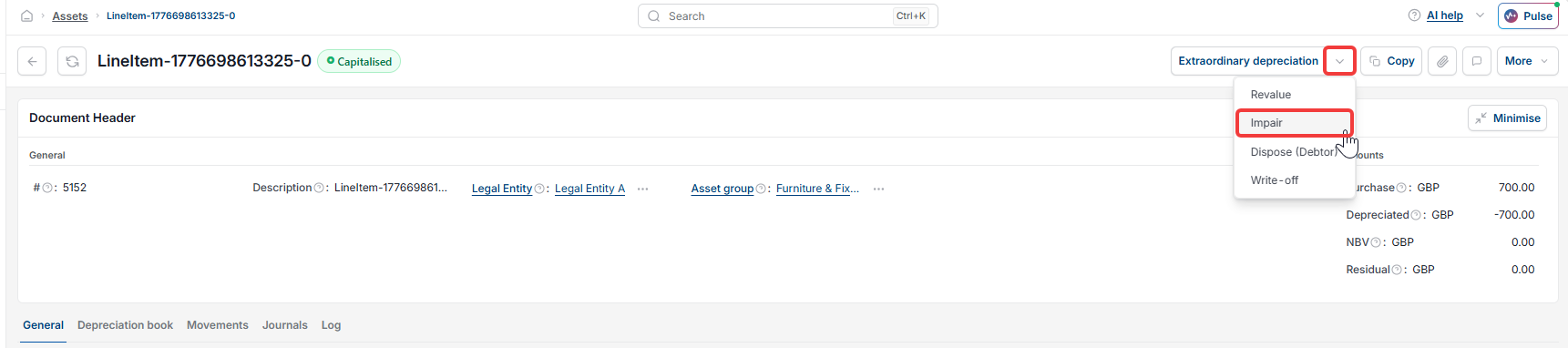
- Open the relevant asset – confirm the status shows 'Capitalised'
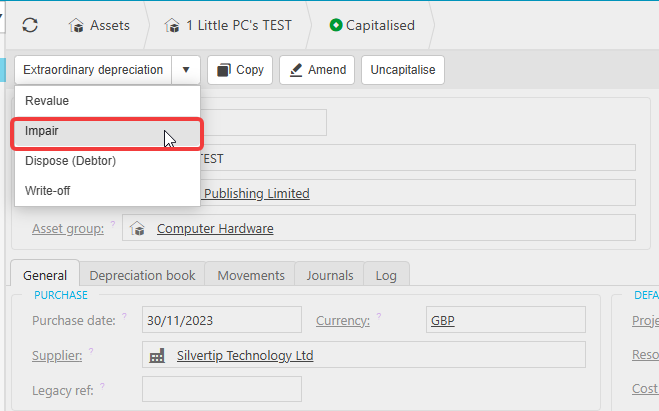
- Select the drop-down arrow next to the movement options
- Select 'Impair'
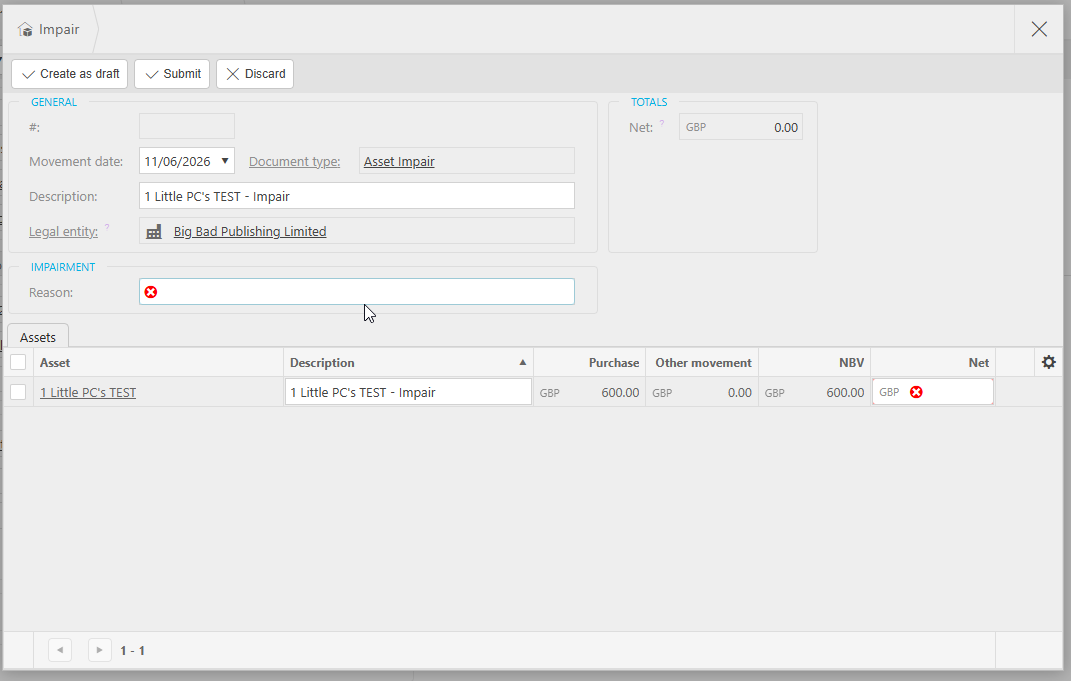
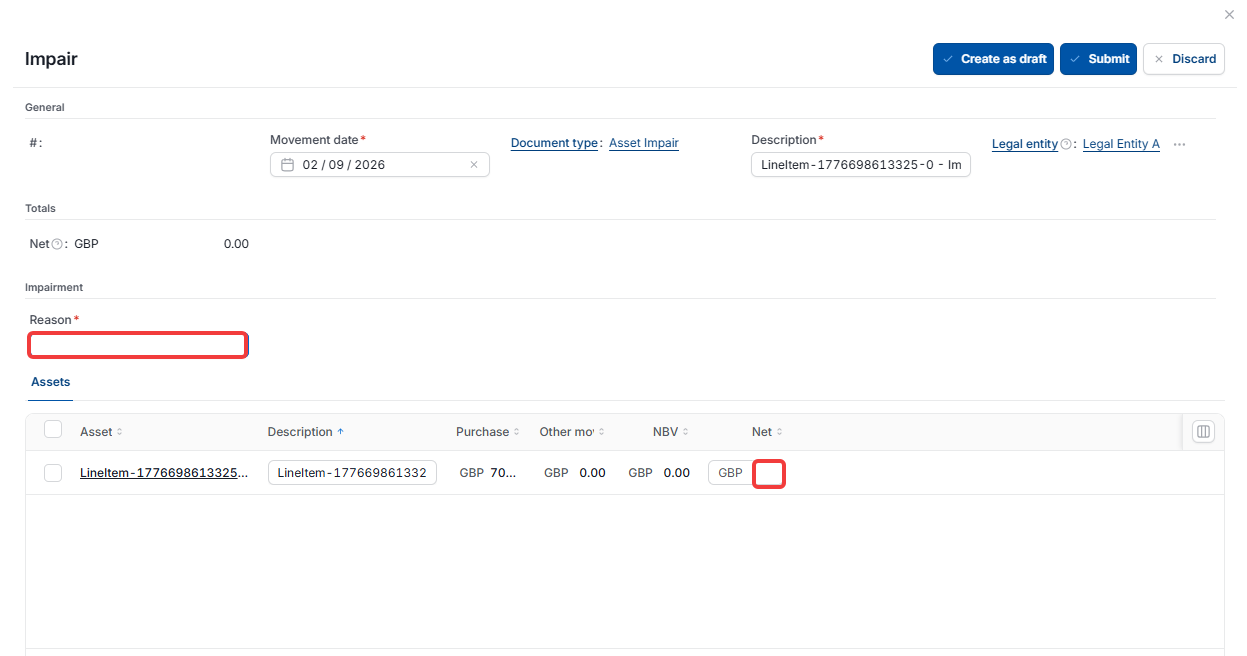
- Confirm or update the 'Movement date'
- Enter a 'Reason' for the impairment – this field is mandatory
- In the assets panel, enter the impairment amount in the 'Net' field – this is the reduction in value you are recording
- Select 'Create as draft' to save the impairment for review before posting, or 'Submit' to post immediately
- Select 'Discard' if you need to cancel without saving.
iplicit creates a journal reducing the asset's net book value by the impairment amount. The 'Impairment charge' account takes the debit entry on the P&L and the 'Impairment' account reduces the asset value on the Balance Sheet. The depreciation schedule recalculates automatically to reflect the new lower carrying value.
Reviewing the impact of an impairment on the depreciation schedule
Once the impairment is posted, open the 'Depreciation book' tab on the asset record to confirm the schedule has updated. The remaining depreciation values will be lower to reflect the reduced carrying value – the asset has less value left to depreciate over its remaining useful life.
Viewing the impairment on the fixed asset record
Once processed, the impairment movement and its associated journal are visible on the asset record under the 'Movements' tab and the 'Journals' tab respectively.
Impair asset
Asset impairment
Partial disposal of asset
Asset impair screen
ASSIMP